South Korea did it with seedlings, soldiers, and stubborn bureaucracy. After the Korean War ended in 1953, aerial photographs showed a peninsula the color of bone — hillsides scoured by artillery, clear-cut for fuel during the Japanese colonial period, and stripped again by refugees who had nothing else to burn. Most of the country’s forests were classified as degraded or bare. Seven decades later, forest cover across South Korea has returned to cover the majority of the national land area, making it one of the few countries in the postwar world to have reversed near-total deforestation on a national scale.
The mechanism was neither miraculous nor purely ecological. It was a decades-long state project — the National Forestation Plans launched in the 1970s — that combined authoritarian planning, village-level labor mobilization, fuel substitution policies, and a rigorously enforced logging ban. The trees came back because the country made it functionally illegal, culturally shameful, and economically unnecessary to cut them down.

The Baseline: A Peninsula Nearly Denuded
The scale of the damage is difficult to overstate. During the 1910–1945 Japanese occupation, Korean forests were harvested aggressively for timber, railway ties, and wartime shipbuilding. What survived was hit again during the Korean War, when napalm, shelling, and the collapse of rural fuel infrastructure sent civilians into the hills with axes. By the mid-1950s, the average standing volume of Korean forests had fallen drastically — far below what would be typical in a healthy temperate forest.
Erosion followed deforestation the way flooding follows erosion. Monsoon rains carved gullies into the exposed slopes, silting rivers and burying rice paddies downstream. Landslides killed hundreds in a typical summer. The Han River, running through Seoul, turned brown for months at a time. Contemporary Korean agricultural reports from the late 1950s described a country whose watersheds were structurally incapable of holding a summer’s rain.
The 1973 Turning Point
Earlier reforestation attempts — under the U.S. military government in the late 1940s and the Rhee administration in the 1950s — had failed for a simple reason: rural Koreans still needed firewood. Planting seedlings on a hillside where families gathered kindling every evening produced predictable results. The seedlings disappeared.
The break came with the First National Forestation Plan in the early 1970s, which paired tree planting with something that had never accompanied it before: an aggressive substitution of coal briquettes (yeontan) for wood fuel in Korean households. The government subsidized briquette stoves, built coal distribution networks into remote villages, and criminalized the cutting of live trees. Village heads were held personally accountable for the survival rate of seedlings planted in their jurisdictions. Schoolchildren were mobilized for annual planting days that still exist as an Arbor Day tradition.
The program planted billions of trees over the following decades. Species selection was pragmatic rather than romantic — fast-growing pitch pine, black locust, and Japanese larch dominated early plantings, chosen because they could stabilize soil quickly on damaged slopes. Native oaks and Korean pines came later, once the initial cover was established.
Why It Actually Worked
Reforestation projects fail more often than they succeed. The World Resources Institute and other monitors have documented restoration commitments across dozens of countries that produced far less than their pledged canopy. What made South Korea’s effort structurally different fell into four categories.
Fuel substitution came first. Without displacing household wood demand, no planting program could survive contact with a cold winter. The briquette policy removed the economic pressure on the forests before the forests were expected to grow back.
Enforcement was severe and local. Illegal logging carried prison sentences. Local officials whose districts underperformed on survival rates were demoted. This was not gentle stewardship; it was an authoritarian regime treating trees as national infrastructure.
Species matched conditions. Rather than planting climax-forest species on ruined soil, planners used pioneer species tolerant of poor substrates. Research on tropical recovery in places like the Ecuadorian Chocó has since confirmed the logic: young regenerating forests often depend on hardy, sometimes non-native pioneers to establish canopy before slower native species can return. An analysis of 1,561 forest plots across ten tropical countries found that non-native trees made up 28 percent of stems in young regenerating forests but declined as native canopy returned — the same successional pattern Korean planners exploited by design rather than accident.
The country urbanized simultaneously. Between 1970 and 2000, South Korea’s rural population fell dramatically. The pressure on marginal hillside farmland collapsed. Abandoned terraces reverted to scrub, then to secondary forest, without any planting at all.
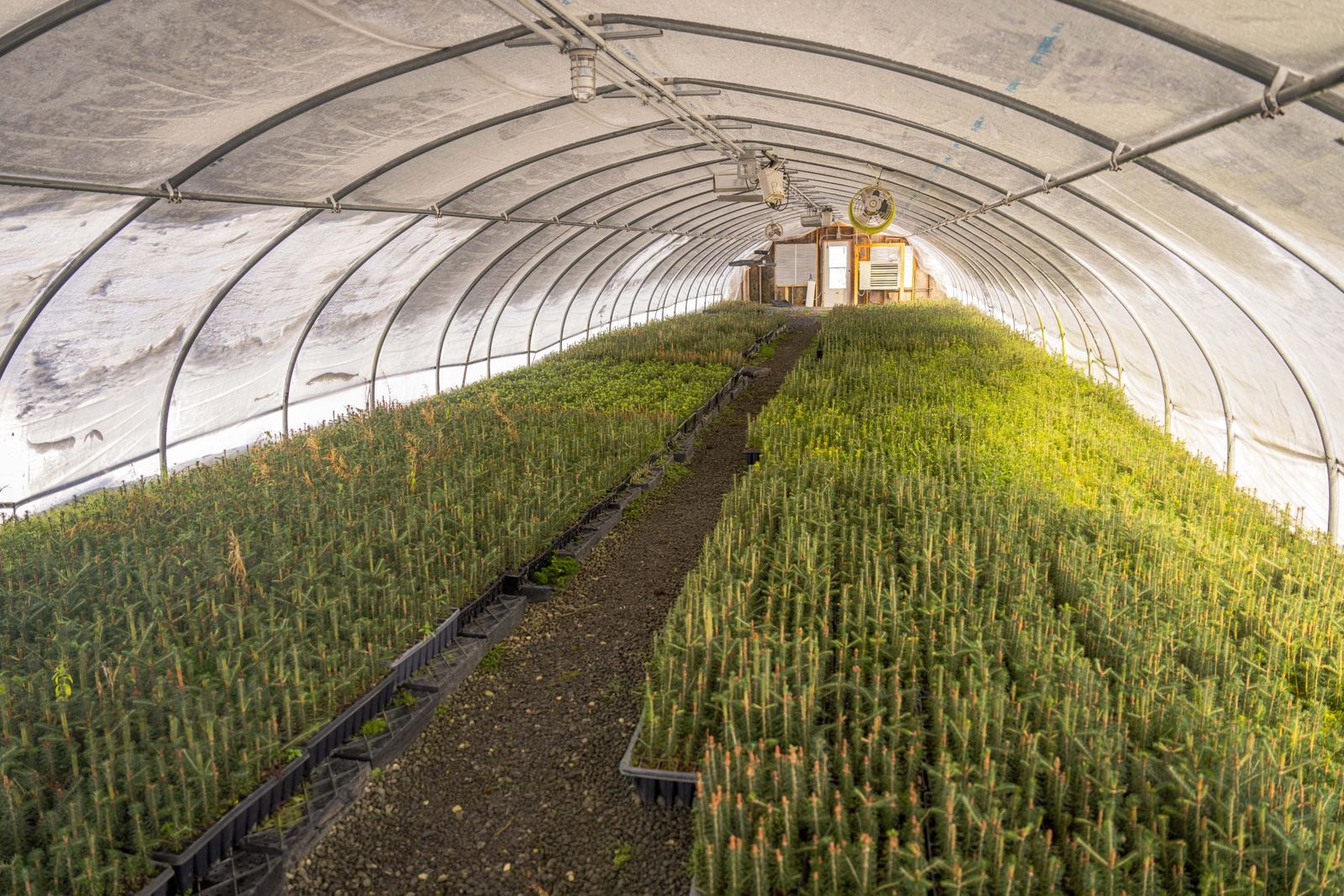
The Forest That Came Back Is Not the Forest That Was Lost
The recovered forest cover is a striking achievement, but ecologists who work in Korean woodlands note that the recovered forest is younger, less biodiverse, and structurally simpler than the pre-colonial baseline. Vast tracts are dominated by even-aged stands of the pioneer species planted in the 1970s. Old-growth ecosystems exist today only in fragments — most notably in the Demilitarized Zone, where decades of enforced human absence have allowed forests to regenerate with minimal disturbance.
This gap between quantity and quality is now a global pattern. The 2025 Forest Declaration Assessment describes what it calls a forest paradox: tropical regions across Latin America and Asia are showing dramatic gains in regenerating cover, even as the ecological richness of what returns lags behind what was lost. A hectare of thirty-year-old plantation is not, functionally, a hectare of primary forest, even if satellites count them identically.
South Korea’s second-generation forestry policy has since shifted toward addressing exactly this deficit — thinning monocultures, reintroducing native hardwoods, and building corridors that reconnect fragmented habitats. The Korea Forest Service now spends more on ecological restoration than on new planting.
The Intergenerational Bet
The philosophical premise of any reforestation program is that people alive today are willing to invest in landscapes they will not live to see mature. A pitch pine planted on a Gyeonggi Province hillside in 1975 is only now approaching structural maturity. The oak that will succeed it may not reach its full canopy for another century. This is the kind of temporal horizon that intergenerational environmental ethics tries to formalize — the moral logic of stewarding a resource whose payoff accrues to descendants.
Korean forestry succeeded in part because it wrapped that ethic in national narrative. Reforestation was framed not as environmentalism, which barely existed as a category in 1970s Korea, but as patriotic reconstruction — the visible restoration of a country that had been physically broken. Arbor Day ceremonies, school planting drives, and village competitions built the practice into what might be called intergenerational environmental behavior: values and practices transmitted through family and community rather than through policy alone.
What the Model Does and Does Not Transfer
Delegations from many countries have studied the Korean case for decades, and the Korea Forest Service now runs an international cooperation arm that exports the methodology. But the transferability is uneven. The Korean program depended on state capacity that few post-conflict countries possess: a functioning rural extension service, enforceable property boundaries, subsidized fuel alternatives, and a political system willing to punish local officials for dead seedlings. Removing any one of those pillars tends to collapse the outcome.
There is also the question of forest regeneration in tropical versus temperate systems. Korean pitch pine and larch grow on schedules that reward decadal planning. Tropical hardwoods, and the ecosystems built around them, operate on different timelines and different vulnerabilities — invasive species like strawberry guava in Madagascar can arrest succession entirely, as Rice University research on Ranomafana National Park has documented. A model that works on Korean granite slopes with pioneer conifers may not translate to a lowland tropical basin under invasive pressure.
Still, the peninsula stands as the clearest counterexample to the assumption that once forests are gone, they are gone. Drive from Seoul toward the eastern coast today and the ridgelines rise in continuous green, thick enough to hide the roads. Somewhere under those canopies, older Koreans can still point out the exact hillsides where, as children, they carried seedlings uphill in tin cans — trees now taller than the houses they came from.