By the early 2000s, the cancer rate in Kargi, a remote desert village in northern Kenya, was three times the national average, according to a recent investigation by The Intercept. The disease most often attacked the esophagus. Sufferers described swallowing goat meat, their primary food source, as feeling like big shards of glass scraping through deep wounds cut into their throats. This was not a village with a genetic predisposition to esophageal cancer or a history of heavy tobacco use. This was a village where, in the 1980s, an American oil company called Amoco drilled nearly a dozen wells, found no oil, and left behind white mounds of toxic drilling chemicals that the impoverished community mistook for salt and used to cook their food.
I spent over a decade in corporate law — first at a major New York firm handling billion-dollar M&A deals, then as in-house counsel at a tech company — and in that time I learned something that applies well beyond boardrooms: the distance between an act and its consequences can be measured in miles, in years, in layers of corporate reorganization. The longer the distance, the harder accountability becomes. The story of Kargi, Kenya, is a study in that distance.
What Amoco Did in the Chalbi Desert
In the mid-1980s, foreign work crews arrived in Kargi and the surrounding Chalbi Desert by helicopter. They wore protective suits. They had bulldozers, land rovers, and guards. Residents of the village, where literacy rates were low, watched with excitement. Kenyan President Daniel arap Moi had commissioned the project, and Amoco’s managing director reportedly expressed optimism about the oil prospects to President Moi based on the rock formations. Locals were hired to cook for the crews. Lebeku Mirgichan, now in his early 70s, worked as a cook for three years, earning wages that at the time represented substantial income for the area.
Amoco, a Midwest-based company that fancied itself on the verge of becoming a global oil power, drilled multiple wells reaching significant depths. The company had drilling rights in Mozambique, Sierra Leone, Tanzania, and Burundi. Kenya was supposed to be another win.
It wasn’t. After several years and no meaningful sign of oil, Amoco decommissioned the project around 1990. The vehicles, guards, and crews left abruptly. Dozens of residents said in court records and interviews that they were never officially informed the project had ended. And no one came to clean it up.
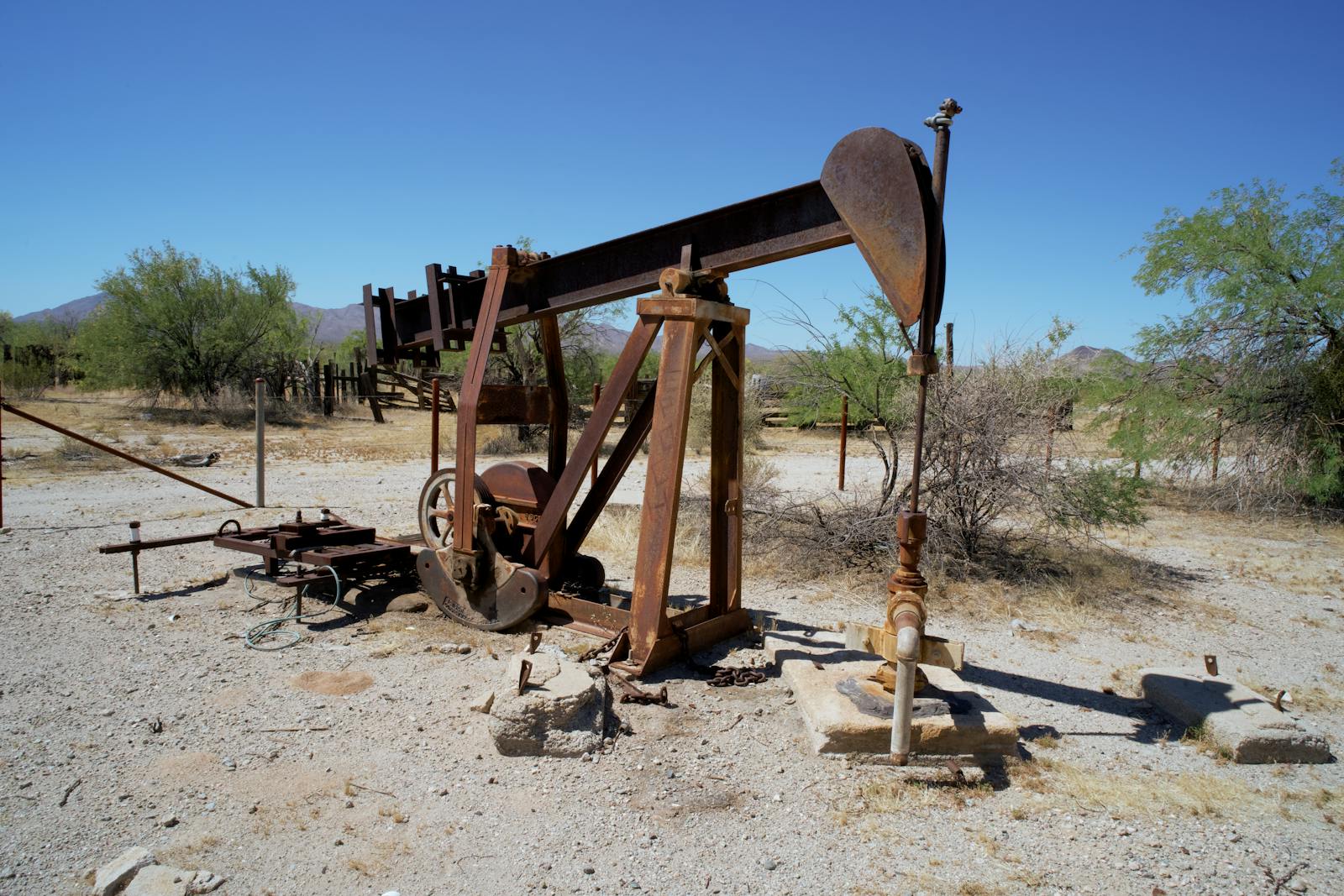
What the company left behind was a dry white substance scattered on the ground near the community’s water wells. The wells themselves had not been properly sealed. The protective-suited workers were gone, but their waste remained in a place where tens of thousands of impoverished people depended entirely on groundwater and livestock for survival.
The “Salt” That Wasn’t Salt
Kargi is one of the most food-insecure places in Kenya. There is no piped water. People survive on the meat and milk of goats, sheep, and camels. When residents discovered the white, flaky substance around the abandoned drill sites, many concluded it was a natural salt deposit. They collected it. They packed it up. They cooked with it. The area earned a local name, kwa chuvmi, which residents say refers to the salt-like substance.
It was not salt. According to Kenyan court documents reviewed by The Intercept, the substance was composed of two heavy drilling chemicals: barite and bentonite. Barite is a mineral used in large quantities to increase the density of drilling fluids. Bentonite, a clay-like substance often called drilling mud, helps carry cuttings to the surface and stabilize boreholes. Engineering experts have noted that these chemicals can have severe effects on the environment and on people.
A subsequent examination by Lundin, a Swedish oil company that was evaluating the area for its own potential exploration, reportedly confirmed that Amoco had used a white material that resembled salt but was essentially a special clay material used in drilling operations. The report found extremely high alkaline levels in the substance, levels that can cause chemicals to be corrosive and destroy skin on contact. Former Amoco employees told The Intercept they remembered watching workers’ skin peel off when handling the drilling materials.
The community used this substance in their food for years.
The Water, the Animals, the Disease
The contamination went beyond what people collected from the ground. High levels of nitrates, a chemical compound used in drilling operations as an explosive to locate oil, a bacteria suppressant, and an additive to strengthen well walls, seeped into the boreholes and shallow wells that served as the only water supply in the desert. Court records indicate that in the 1990s, livestock died after drinking water from a borehole next to one of Amoco’s abandoned wells in the neighboring village of Balesa.
Then came a mass die-off. In the early 2000s, thousands of sheep and goats perished. A government water quality report confirmed that over 600 animals died within two hours of drinking the water. The water was found to contain dangerously high levels of nitrates. When consumed in large quantities, nitrates stop mammals’ blood from carrying oxygen.
Water tests conducted in the late 2000s found that the water supply did not meet World Health Organization standards. The Kenyan water resources authority declared the water unsafe for human consumption. A local nonprofit organization found high levels of both nitrates and arsenic, another known carcinogen commonly associated with drilling operations. The nonprofit concluded that these contaminants were the probable cause of the livestock deaths.
And the people were drinking the same water.
Gumathi Galnahgalle, a village elder, told The Intercept that the community began noticing people falling ill in the years after Amoco departed. When his mother could no longer swallow food, he brought her to the hospital multiple times. Mirgichan said hospital staff told him there was no treatment available for his mother and that he should take her home. Mirgichan said the disease has affected every household in the area.
A government fact-finding team sent to the area in the early 2000s reportedly recommended that infants not be given the water and that toxicology tests be conducted. A government report from that period indicated that concerns about esophageal cancer were widespread throughout the region according to medical personnel and community members.
The Gap Between Evidence and Proof
I need to be precise here, because precision matters in cases like this. The Intercept’s investigation is careful to note that a lack of adequate testing and a general neglect of Kargi makes it difficult to directly prove that the waste Amoco left behind caused the cancer epidemic. That qualification is honest and important. Correlation is not causation, and no thorough epidemiological study has been completed.
But consider what the available evidence does show: a remote community with no prior history of elevated cancer rates; the arrival and departure of an oil company that left behind unsealed wells and carcinogenic drilling waste; contamination of the only water supply with nitrates and arsenic, both known carcinogens; a mass die-off of livestock; and a cancer rate that climbed to three times the national average, concentrated in cancers of the esophagus and stomach, the very organs most exposed to ingested contaminants.
I learned early in my career, sitting across the table from executives in deal rooms, that what people say and what systems actually produce are rarely the same thing. Contracts are psychological documents — every clause reveals what the drafter feared. In Kargi, the absence of a definitive scientific study becomes a shield. No study, no liability. No liability, no cleanup. No cleanup, no remedy. The legal framework demands proof that may be structurally impossible to obtain in a community this poor and this remote. This is a pattern I’ve seen replicated across different contexts: the burden of proof falls on the people least equipped to carry it.
Neither BP (which acquired Amoco in a $48 billion deal in 1998, the largest foreign takeover of an American company at the time) nor the Kenyan government responded to repeated requests for comment from The Intercept. No official cleanup has ever been conducted.
A Landmark Lawsuit and Its Slow Progress
In 2020, residents of Kargi and other Chalbi Desert communities filed what became the first-ever lawsuit based on Kenya’s constitutional right to a safe and healthy environment. They sued the Kenyan national and county governments, demanding clean water for people and livestock and holding Kenya accountable for failing to police Amoco’s environmental damage. Six years later, the case is still working its way through the court system.
The suit targeted the government, not BP. The logic is straightforward, if painful: a sovereign government that grants a foreign company access to its land and people has a duty to ensure that company does not poison them, or at least to clean up after it does. The Kenyan constitution, adopted in 2010, guarantees the right to a clean and healthy environment. The question is whether that guarantee means anything in practice for communities like Kargi.
The Amoco case has opened a wider pattern of litigation across Kenya. Similar cases have emerged nationwide, accusing local and national governments of failing to clean up waste left behind by other multinational oil companies. The story of Kargi is not an isolated incident. It is a template.
Omolade Adunbi, director of the African Studies Center at the University of Michigan, said oil exploration was initially welcomed by many communities due to its promised economic opportunities. The promise came. The development did not.
A Problem Far Larger Than Kenya
The contamination of communities by oil and gas operations is not confined to East Africa. In the United States, air pollution from the oil and gas industry causes an estimated 91,000 premature deaths every year. In South Sudan, the government has ignored reports linking oil pollution to birth defects in communities living near production sites. The pattern repeats: extraction in poor communities, contamination left behind, accountability deferred or denied entirely.
What distinguishes Kargi is the combination of extreme poverty, extreme remoteness, and the perverse detail that the victims literally ate the poison because they mistook it for something nourishing. There is something about that fact that resists being processed as mere data. People so hungry they collected a white powder left by an oil company and seasoned their food with it. The company knew what the substance was. The community did not.
Kenya’s own oil ambitions have continued despite these unresolved harms. Gulf Energy recently secured a $15 million onshore oil rig ahead of the South Lokichar project in Kenya’s Turkana region, signaling that the country’s oil future is expanding, not contracting. The question is whether the lessons of Kargi will travel to the next drill site.
What Accountability Looks Like When It’s Missing
Amoco’s failure in Kargi was a business failure. The company drilled for several years and found no oil. When the project became unprofitable, it left. The protective suits the workers wore told the company everything it needed to know about the danger of the materials. The community, watching men dressed like astronauts, had no way to understand what the suits meant. That information asymmetry is the hinge on which this entire tragedy turns.
In 1998, BP bought Amoco and inherited its assets and, presumably, its liabilities. Most Amoco gas stations in the United States were rebranded. The $48 billion deal was celebrated as a landmark of global business. In Kargi, the white substance sat on the ground. People kept cooking with it.
I have spent much of my professional life believing that working within flawed systems to improve individual outcomes is meaningful work. I still believe that. But the Kargi case forces a harder question: what happens when the system is not merely flawed but absent? When the courts are too far away, the testing too expensive, the science too incomplete, and the company too large and too gone to answer for anything?
The residents of Kargi did what people always do when institutions fail them. They filed a lawsuit. They told their stories to journalists. They buried their dead and pointed at the white powder on the ground. The lawsuit is six years old now and still moving. BP has not responded. The Kenyan government has not responded. The “salt” is still there.
Every executive I ever sat across from in a deal room was present at the table. They heard the terms. They faced the consequences of what they agreed to. The particular cruelty of Kargi’s situation is that the entity responsible for the harm has never appeared in any forum to answer for it. Not in court, not in the press, not in the village. That absence is its own kind of verdict, one that says more about the distribution of power in the world than any contract clause I ever negotiated.
The people of Kargi are still waiting.
Photo by Tom Fisk on Pexels